

How To Find A Leak In A Aluminum Boat
How To Find And Fix A Gunkhole Leak
At some phase, most boats will develop a leak. Here nosotros look at leaks below the waterline and how to detect and fix them.
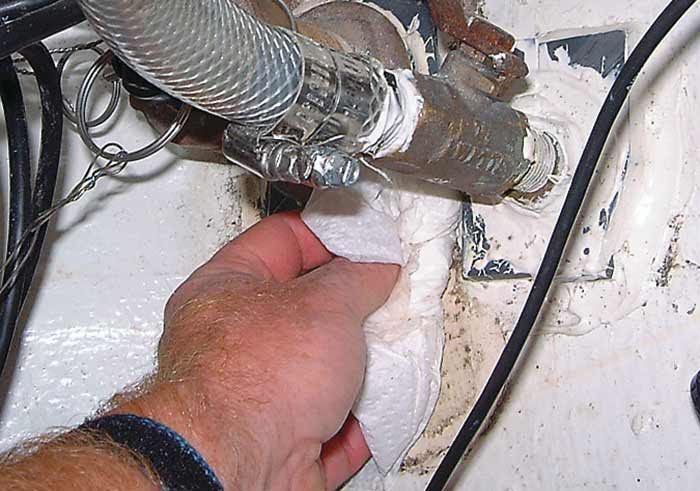
Use a paper towel to thoroughly dry the plumbing equipment and surround.
Although at that place are rare examples of the coveted dusty bilge, most owners look to do a trivial dewatering on their boat occasionally. However, leaks from above and leaks from below are not created equal. Discounting rainwater leaks, some boats are tighter than others and it's important to know what the normal bilge water accumulation is for your gunkhole. Mental calculations may be required to assess the "normal" state.
Here'southward a good example. The stuffing box drips every 15 seconds, yielding .12 fluid ounces in 15 minutes and translating to about one quart every three days or so. Non a large deal. If you lot know what's normal for your boat, you should be able to judge when a leak is getting worse. A bilge pump counter (bachelor at West Marine) is an excellent investment that can be wired into the bilge pump excursion to alarm you lot to potential leaks that might otherwise go unnoticed. Just beware of the faulty logic that a leak ignored volition eventually cease.
Unexpected h2o beneath the floorboards tin can be a scary surprise and a mystery leak should make you nervous. After all, you don't know if information technology'southward a pocket-size issue, such as that pesky tapered plug on a worn seacock, or the harbinger of doom, a critical component somewhere that is hanging past a thread and merely waiting for the right Irish potato's Police force moment to permit become. There can be no peace of heed until the leak is identified and stock-still.
Finding The Leak To Nowhere
Often, finding the leak is more than time consuming and hard than fixing information technology. This is why many repair facilities oft suggest: "Yous find it, we'll set up information technology." That can be coin-saving advice.
Easy-to-detect leaks occur at hull fittings. Tools required to find these leaks are simple: a ringlet of newspaper towels, flashlight, and small mirror. Cheque the within skin of the hull by hand for wetness trickling downward from any thru-hull, rudder port (oft visually inaccessible), the shaft log, stuffing box, and strut fasteners. Other culprits are trim tab and swim-platform mountings. If information technology feels wet, move in for a closer inspection. Use the paper towel to dry off the hull and the fitting, and inspect closely using the flashlight. Expect for the showtime appearance of a trickle or drip. Dry it again and verify y'all are seeing the first point of emergence. Utilise the mirror to cheque the backside of the plumbing equipment. On a thru-hull, for instance, it'due south of import to determine if the bedding chemical compound sealing the thru-hull is leaking, or if it's an attached valve or hose.
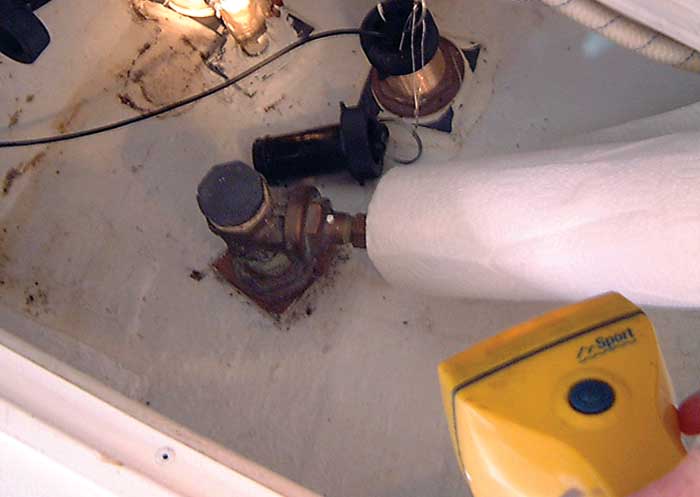
Tools of the trade: flashlight, paper towel, and fingertips.
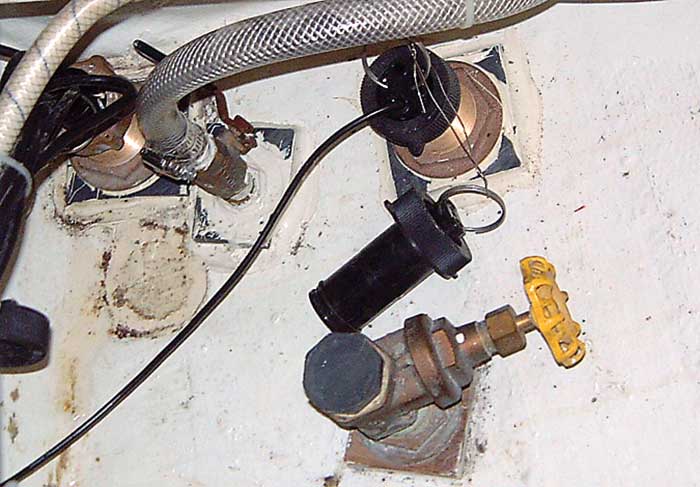
Leaks at skin fittings are comparatively piece of cake to observe.
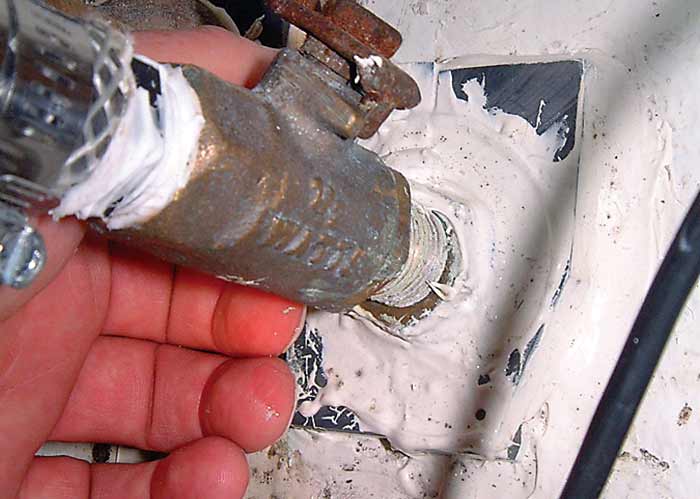
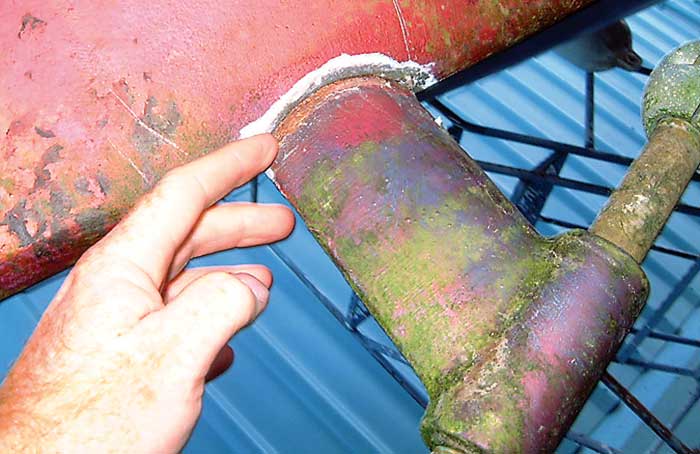
Fingertips are a superb wetness sensor, often finding a leak that is impossible to run across.
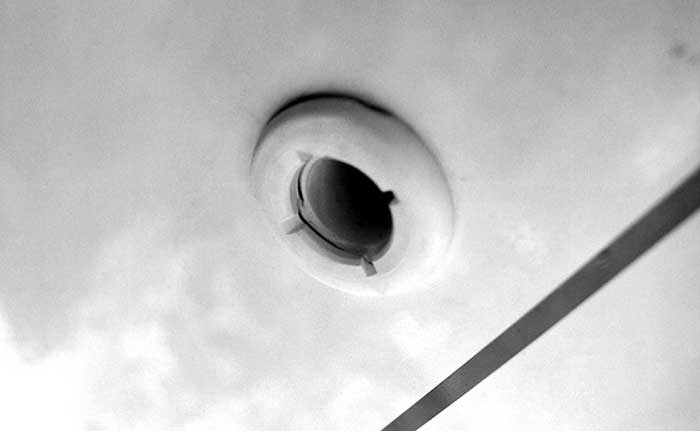
Pay attention to fittings above the waterline. The crack in this plastic plumbing fixtures ways the boat need only sink almost an inch or two before it floods.
On a stuffing box or rudder port, you lot must differentiate between a routine drip at the packing gland, which can be controlled by an adjustment of the stuffing box basics, and a more than sinister leak from a cracked shaft log tube or from nether the bankroll plate of a rudder port assembly.
Finding a leaking keel commodities on sailboats requires that the bilge or keel sump be mopped perfectly dry out and so that the very beginning drop of water welling upwardly from under a backing plate or, worse, from a crack can be positively identified. Powerboats with stern drives most commonly suffer from leaks originating at the U-joint or the bellows. These can be hard to see but look for a slight trickle of h2o on the inside of the transom below the transom assembly. Many of the sources of the leaks described simply get credible when the boat is underway, "working," and then to speak. Seeing them when the boat is quietly adrift in its berth may be incommunicable. What happens if all the below-the-waterline fittings on the hull check out as dry out merely the bilge keeps filling upward with water? At this point, detective piece of work is required, employing a logical methodology to follow the clues.
Outset Clue: When Does The Leak Occur?
If, for example, h2o in the bilge stops rise at the same fourth dimension the water tank is found empty, it'south logical to conclude the ii are related. That's an like shooting fish in a barrel one. Is the leak constant whether underway or at the dock? If it just occurs underway, does information technology happen at every outing, merely in big sea conditions, or only at certain speeds? Whatever intermittent leak needs to be caught "in the human action," requiring you to carry out testing underway to indistinguishable the circumstances under which the leak occurs. The waterline of whatever boat moving at displacement speeds peaks at the bow wave and the stern quarter-wave. This can submerge thru-hulls that are well higher up the waterline at rest. Other intermittent leaks can originate at the engine cooling arrangement or running gear and will simply bear witness upward when the engine is running. If a sailboat only leaks when it'due south heeling over, a keel bolt or keel sump crack leaking nether load or a fitting on the leeward hull side siphoning into the bilge might exist implicated. In this case, change tacks and observe what happens.
2d Inkling: Where Does The Leak Originate?
If the leak is constant, dry the bilge and identify the direction from which the showtime trickle arrives. This volition at to the lowest degree narrow the search for the betoken of entry to port, starboard, forward, or aft. However, leaks are devious and boats are built with hidden conduits and inaccessible compartments. The location at which the leak exits into the bilge may be a long style from its entry point into the hull.
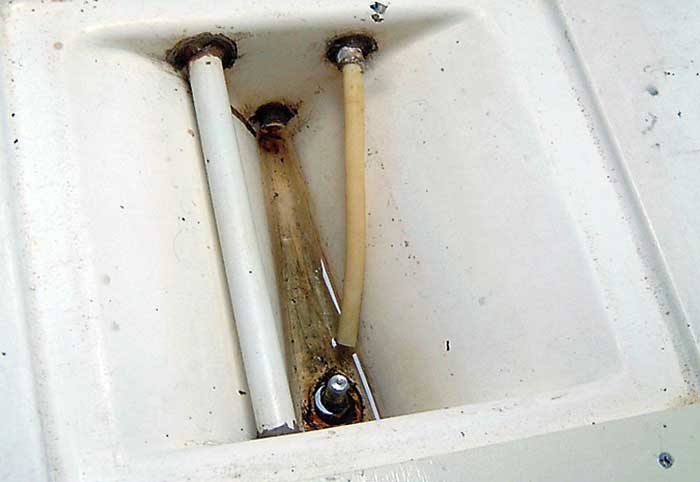
Inner liner mystery leaks: H2o arrives via the limber holes and collects in the bilge sump, just where does it originate?
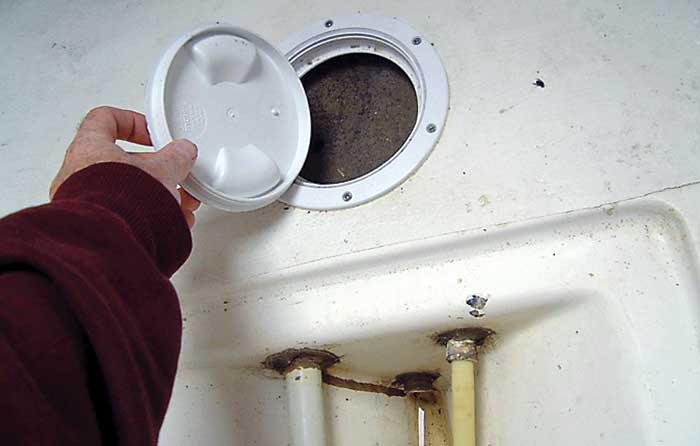
Adding an inspection port in the liner or double bottom tin open inaccessible locations.
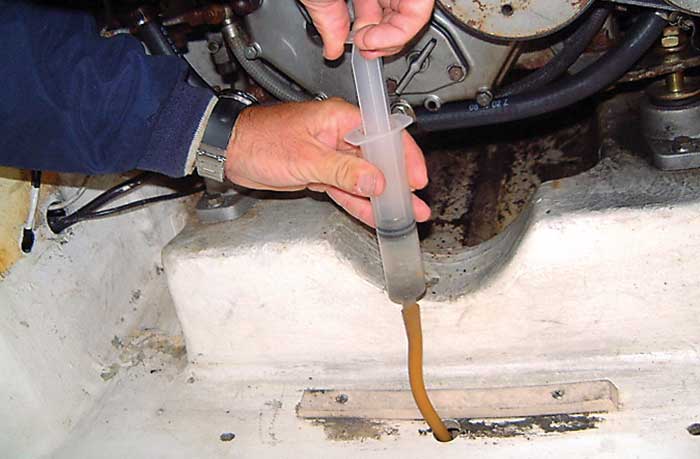
Inaccessible spaces below the flooring may hold water, requiring you to cut an access hole to get a pump in there.
This embedded prop shaft strut is suspected of causing a hidden leak. Whether the repair was successfully volition exist known after launch.
If the leak appears to originate from inside a closed compartment or from under the border of a hull liner, it may be necessary to cut an access hole and install an inspection port to shut the hole later on.
Leaks on sailboats with full keels and encapsulated internal ballast can exist catchy to diagnose. These boats usually have two lines of defense. The hull skin itself is the starting time defence force and is commonly a very thick layup at the leading border and keel lesser. Given that boats with deep keels do occasionally run aground, the architect will usually cap the ballast with a secondary glass layer across the top of the keel. This secondary defence forms the floor of the bilge and will go along the gunkhole dry in the event the hull skin is holed. Information technology's condom to presume that if at that place is a leak at the inner skin, there must also be a leak at the outer peel.
Powerboat hulls, too, can often hibernate problems. Many have a double lesser filled with flotation foam or arranged with liners so that the inner peel of the hull cannot be seen without destructive measures. If the leak'south origins are truly hidden, the best option is to haul the boat and search the outside of the hull for damage. It helps to leave the bilge total of water and look for the telltale trickle of water leaking out.
Fixing Leaks
Leaks at hull fittings, such as seacocks, valves, hoses, instrument senders, and running gear, are common and usually straightforward to set up. Generally, any leak at the bedding compound sealing a thru-hull or hardware bolted through the hull requires hauling the gunkhole and complete removal and reinstallation of the fitting. Attempts to add "broth" to the exterior perimeter of the fitting, or the inside, rarely succeed. Unfasten and remove any hoses or valves and then unscrew the clench nut or individual fastening bolts securing the fitting. After cutting abroad as much former sealant every bit possible, a thru-hull can usually be pushed or knocked out from inside the boat. The old sealant volition probably have a potent grip (even though it's leaking) and it may be necessary to "gently" break the plumbing fixtures loose with a dead-blow hammer. This tin be a wood mallet or even a small-scale sledge, provided yous use a softwood block between a steel hammer and the plumbing fixtures.
Through-bolted hardware with an external flange such as a rudder port or prop shaft strut will probably demand to exist wedged and carefully pried loose. A 2-inch or wider chisel works well for this. After removal, clean all the old sealant off the hull and fitting. Bank check the plumbing fixtures advisedly for cracks or corrosion. Proper reinstallation requires lots of polyurethane sealant under the outside flange, on the edges of the hull opening, and on the within of the hull under the backing block. Supercede whatsoever onetime wood bankroll blocks with new forest or, even improve, a piece of UHMW polyethylene or some StarBoard scraps. Replace any corroded fasteners with new ones.
While yous're at it, inspect the hose connected to the thru-hull. Replace any cracked, weathered, or substandard hoses and inspect hose clamps, also. If at that place is a garden-variety gate valve on a thru-hull, supersede it with a quarter-plough ball valve or seacock that meets the fabric and testing requirements of ANSI/UL 1121, as specified by American Gunkhole and Yacht Quango (ABYC) standard H-27.5.2.
Related Articles
Author
Nick Bailey
Correspondent, BoatUS Magazine
Nick Bailey has more than three decades in the boat-repair business concern and is service manager of Bristol Marine in Mississauga, Ontario.
BoatUS Magazine Is A Do good Of BoatUS Membership
Membership Benefits Include:
-
Subscription to the impress version of BoatUS Magazine
-
iv% back on purchases from West Marine stores or online at WestMarine.com
-
Discounts on fuel, transient slips, repairs and more at over 1,200 businesses
-
Deals on cruises, charters, car rentals, hotel stays and more than…
-
All for only $25/yr!
Source: https://www.boatus.com/expert-advice/expert-advice-archive/2011/february/how-to-find-and-fix-a-boat-leak
0 Response to "How To Find A Leak In A Aluminum Boat"
Post a Comment