

Hydrogen 1 Protons Neutrons Electrons
Chapter ii Minerals
2.1 Electrons, Protons, Neutrons, and Atoms
All matter, including mineral crystals, is made upwardly of atoms, and all atoms are fabricated up of three main particles: protons, neutrons, and electrons. Equally summarized in Tabular array two.1, protons are positively charged, neutrons are uncharged and electrons are negatively charged. The negative charge of one electron balances the positive charge of one proton. Both protons and neutrons take a mass of 1, while electrons take about no mass.
| Elementary Particle | Charge | Mass |
|---|---|---|
| Proton | +1 | i |
| Neutron | 0 | ane |
| Electron | −1 | ~0 |
The chemical element hydrogen has the simplest atoms, each with just one proton and one electron. The proton forms the nucleus, while the electron orbits effectually it. All other elements have neutrons besides as protons in their nucleus, such as helium, which is depicted in Figure 2.2. The positively charged protons tend to repel each other, and the neutrons assistance to hold the nucleus together. The number of protons is the diminutive number, and the number of protons plus neutrons is the atomic mass. For hydrogen, the atomic mass is i because at that place is ane proton and no neutrons. For helium, it is four: two protons and ii neutrons.
For most of the 16 lightest elements (up to oxygen) the number of neutrons is equal to the number of protons. For most of the remaining elements, at that place are more neutrons than protons, because extra neutrons are needed to keep the nucleus together by overcoming the mutual repulsion of the increasing numbers of protons concentrated in a very minor space. For example, silicon has xiv protons and 14 neutrons. Its diminutive number is 14 and its atomic mass is 28. The most mutual isotope of uranium has 92 protons and 146 neutrons. Its diminutive number is 92 and its atomic mass is 238 (92 + 146).
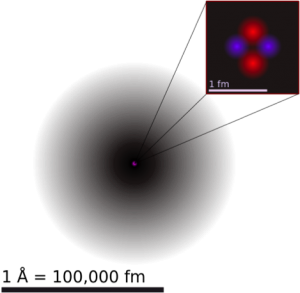
The dot in the middle is the nucleus, and the surrounding cloud represents where the 2 electrons might be at any time. The darker the shade, the more than probable that an electron will be there. An angstrom (Å) is 10-10k . A femtometre (fm) is 10-15m. In other words, a helium cantlet'southward electron cloud is nigh 100,000 times bigger than its nucleus.
Electrons orbiting around the nucleus of an cantlet are bundled in shells — also known as "energy levels." The starting time crush can concur only two electrons, while the next crush holds upward to viii electrons. Subsequent shells can hold more electrons, only the outermost beat out of any cantlet holds no more than than 8 electrons. The electrons in the outermost shell play an important function in bonding between atoms. Elements that accept a full outer trounce are inert in that they do non react with other elements to class compounds. They all announced in the far-right cavalcade of the periodic table: helium, neon, argon, etc. For elements that practise not have a full outer shell, the outermost electrons tin can interact with the outermost electrons of nearby atoms to create chemical bonds. The electron shell configurations for 29 of the first 36 elements are listed in Table 2.2.
| Number of Electrons in Each Shell | ||||||
|---|---|---|---|---|---|---|
| Chemical element | Symbol | Atomic No. | First | 2nd | Tertiary | Quaternary |
| Hydrogen | H | 1 | 1 | |||
| Helium | He | 2 | 2 | |||
| Lithium | Li | 3 | 2 | 1 | ||
| Beryllium | Be | 4 | 2 | 2 | ||
| Boron | B | 5 | 2 | 3 | ||
| Carbon | C | 6 | ii | 4 | ||
| Nitrogen | N | seven | 2 | 5 | ||
| Oxygen | O | 8 | 2 | 6 | ||
| Fluorine | F | 9 | 2 | seven | ||
| Neon | Ne | 10 | 2 | viii | ||
| Sodium | Na | 11 | two | 8 | 1 | |
| Magnesium | Mg | 12 | ii | 8 | 2 | |
| Aluminum | Al | 13 | 2 | 8 | 3 | |
| Silicon | Si | fourteen | 2 | 8 | four | |
| Phosphorus | P | 15 | two | 8 | 5 | |
| Sulphur | S | xvi | 2 | eight | half dozen | |
| Chlorine | Cl | 17 | 2 | 8 | vii | |
| Argon | Ar | 18 | 2 | 8 | 8 | |
| Potassium | Grand | 19 | two | 8 | eight | 1 |
| Calcium | Ca | 20 | 2 | 8 | eight | two |
| Scandium | Sc | 21 | two | 8 | 9 | 2 |
| Titanium | Ti | 22 | 2 | 8 | 10 | 2 |
| Vanadium | Five | 23 | ii | eight | 11 | 2 |
| Chromium | Cr | 24 | 2 | 8 | 13 | one |
| Manganese | Mn | 25 | 2 | eight | 13 | 2 |
| Iron | Fe | 26 | 2 | 8 | 14 | two |
| . | . | . | . | . | . | . |
| Selenium | Se | 34 | ii | 8 | 18 | vi |
| Bromine | Br | 35 | 2 | 8 | eighteen | 7 |
| Krypton | Kr | 36 | 2 | 8 | xviii | 8 |
Attributions
Figure 2.2
Helium Atom by Yzmo is nether CC-BY-SA-3.0

Hydrogen 1 Protons Neutrons Electrons,
Source: https://opentextbc.ca/geology/chapter/2-1-electrons-protons-neutrons-and-atoms/
Posted by: evanssupuldn72.blogspot.com
0 Response to "Hydrogen 1 Protons Neutrons Electrons"
Post a Comment